Visuals bring clarity about the complexity

My takeaway from conversations that I captured visually

Our brain has great difficulty understanding a complex system with only words. A visual can bring clarity about the complexity and eventually show that what appears to be complex is just complicated.

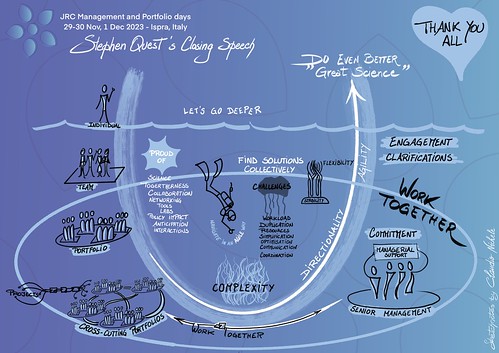
Over 200 colleagues from across the JRC, the European Commission’s science and knowledge department, met for the launch of their future new transversal working structures, the JRC scientific portfolios. The goal was to engage and discuss around the journey they are about to embark upon together. As with any departure, there was excitement but also some fear sometimes in the face of the unknown.

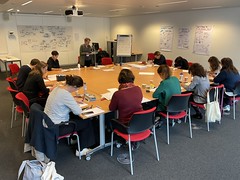
During a large World Café exercise, colleagues discussed the many outstanding issues, roles and responsibilities, collaboration, resources, to name but a few. At the end, each conversation table shared their main conclusions with everyone. The large number of points, open questions, as well as the numerous interlinkages, made it difficult not to qualify the portfolios system as complex.

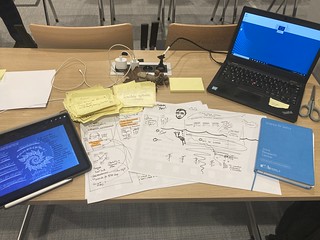
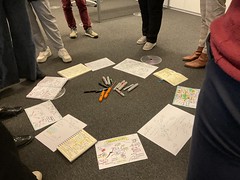
My task was to take visual notes of the conclusions, the typical graphic harvesting of a World Café. Because it was too much, too dense and fast, I just noted on post-its the key words and few arrows. Afterwards I put on a large paper a first draft of all of that. Only then did I reorder the points and the connections to create a mind-map on my iPad.

In his report after the event in which he used my visuals, Stephen Quest, the JRC Director-General, said “the portfolios must not become another layer of complexity. Rather, we need to use them to help navigate our complexity.” I am happy and proud to have been able to bring clarity to this apparent complexity with my visual, and I hope I have reduced it to something only complicated.

Graphic recording at the JRC portfolios launch event

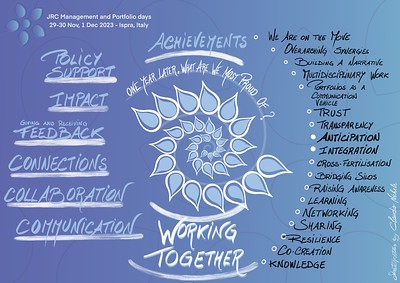
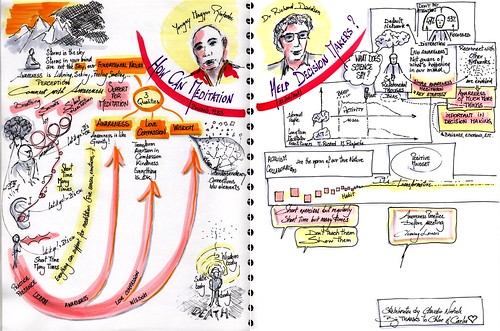
Two other graphic recordings of the presentations the day before:

Graphic recording at the JRC portfolios launch event Graphic recording at the JRC portfolios launch event

And the video to illustrate my visual thinking process in three steps: post-its > draft on large paper > mind map on iPad.

Share on:

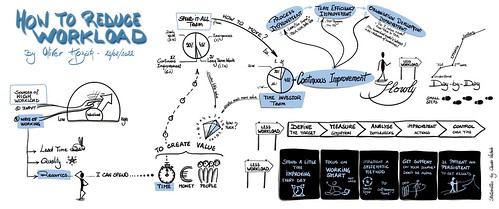
How to reduce workload?

Who has never wondered how to reduce their workload? But who has never found a solution to the question, which is not episodic or ridiculous in terms of real benefits?

My colleague Oliver Kozak brought his scientific and systemic approach to present how continuous improvement can help us to really reduce worlkload.

The objective is to free up enough time to be able to start improving, in order to free up even more time up to 40% to be able to improve continuously and ultimately create much more value at work (by moving from the Spend-It-All team model to the Time-Investor team model). How to get there concretely? By improving in three areas: (your) work processes, team efficiency, and organisation development. Important: you have to go slowly, step by step, with persistence day after day, be patient, and get support.

My visual notes of Oliver’s presentation.

How to reduce workload? sketchnotes
Share on:

Three models of change

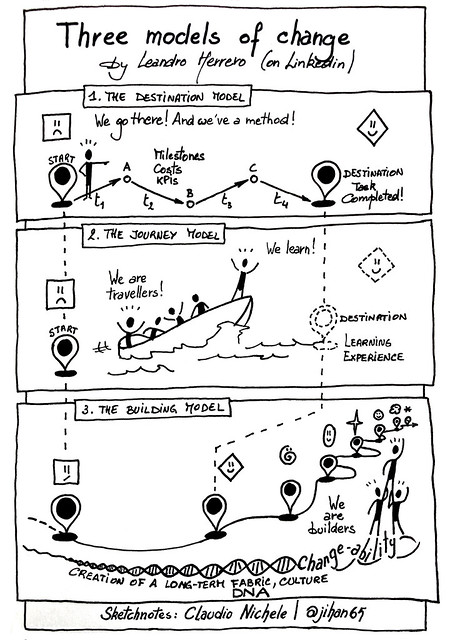
I read in the train this Leandro Herrero’s article on the three models of change and to better remember it I sketched it.

In a nutshell, the article rightly says that traditional change management, the destination model, is often just a one–off. The journey model is about learning and experience. And the building model is about creating a long term culture with change-ability in the organisation DNA.

Three models of change, sketchnotes
Share on:

Trust: an essential ingredient for teamwork

My colleague Valeria Croce asked me to record visually two fantastic sessions she organised on “Trust” with renowned speakers. I reproduce here, to accompany my visual notes, the essential passages of the articles that Valeria wrote after the sessions, as a report.


Resilient teams: how trust underpins care and performance in teams

Resilient teams: how trust underpins care and performance in teams - Sketchnotes

To trust each other at work is even more important in the context of hybrid or remote work, with limited human interaction and the difficulty to reach out to new people!

Chris Tamdjidi shared with us the evidence and learnings he collected through the years working with teams inside and outside the Commission, focussing on the important role of trust in teamwork. He observed that:

  • It is difficult to build a culture of collaboration: while most teams have established processes to perform tasks, they don’t have established processes to improve how they work together,
  • During Covid he observed an increase in individual productivity, but a decrease in collaborative productivity: it takes more effort to connect with others and collaborate in a remote setting.
  • We risk to work in micro-silos, narrow connections because of remote working – we maintain the relationships we already have, it takes efforts to build new ones.

This is why it is important to build team habits that help strengthen collaboration, team resilience and trust, especially in a hybrid environment. These habits are: Habits of attention; of connection; and of positivity.


Why being trusted (or distrusted) matters

Why being trusted matters? - Sketchnotes

Trust is critical to create an environment where colleagues collaborate, share knowledge, engage and contribute to the achievement of the shared purpose. Yet, trust-based relationships require time to be built. What can we do to start building trust from the very beginning of a new collaborative project with colleagues from outside our team or unit?

Hilary Sutcliffe and Vanja Skoric shared lessons they learned working for over 130 civil society projects.In a nutshell, they identify four areas, where most barriers to trust and collaboration can be found, namely:

  • Prior experiences and assumptions
  • Skills and procedures
  • Culture and incentives
  • Process concerns

Three aspects that are crucial to overcome barriers are: A (truly) shared purpose; a trustworthy process (based on seven drivers of trustworthiness: openness, integrity, competence, inclusion, respect and fairness); and a visible impact.

See also Hilary Sutcliffe’s blog post where she talks about this session, and says “[…]this wonderful graphic interpretation of the event by Claudio Nichele“.

Share on:

Knowledge Management and Collaboration in international organisations: Edge or Curse?

Three drawings to illustrate in an offbeat way, and probably memorable way, the participants’ conversations during a session on knowledge management.

The session hosted by Huy-Hien Bui and Fania Pallikarakis, whose full title is “Knowledge Management and Collaboration in international organisations: Edge or Curse?”, was held as part of the Friends of Career Development Roundtable (FoCDR) workshop in Brussels on 17 June 2022.

KM and collaboration workshop - Sketchnotes
Share on:

Hosting and harvesting online VS physical

On 5 May, Amy Lenzo (*) gave an online masterclass on “Hosting and harvesting online VS physical” to the community of practitioners of the Art of Hosting at the European Commission (**). My takeaways (actually apply to any online session):

“It’s not a question of technology, it’s a question of relationships” 

  • 90% of your experience, skills, practice as organiser of physical events can be transposed into online events. Reassuring, isn’t it?
  • The quality of your presence, trust and how you hold space, are just as important online as in the physical world
  • Never host alone an online session, be part of an hosting team
  • The hosting team must consist of at least one process host and one tech host (for all technical aspects) or more for large groups
  • The use of the camera is mandatory for speakers, and highly recommended for all participants (with muted mikes)
  • To keep participants’ attention, speakers can only use the visible/audible part of their body language: their face and their voice. Then, it’s crucial to smile with the whole face and to have a catchy tone and rhythm of voice
  • Keep in mind that everything is amplified online: your voice, your unconscious bias, space and time.
Hosting and harvesting online VS physical, graphic recording

This was also my first live graphic recording using the Procreate app (***). Only a few days after installing it on my tablet (it’s crazy, I know, but I like these challenges). My first learnings to start with Procreate:

  • Many years of experience with layers on Photoshop has helped me a lot. If you’re not familiar with layers, take time to learn how they work and to play with them
  • Select your fave brushes in advance. You can waste precious time looking for what you need during a live event. Mine were Technical pen, Acrylic and Wet Acrylic, and Hard Airbrush (I still have to learn how to have them available in one click)
  • Select your fave colours in advance for the same reason as for the tools (I still have to learn how to create my colour palette in advance)
  • Know the undo/redo gestures

(*) Amy Lenzo on LinkedinTwitter

(**) At the European Commission, the Art of Hosting is called the Art of Participatory Leadership

(***) https://procreate.art/ipad

Share on:

Teleworking mindfully

Being forced to work from home due to the coronavirus pandemic brought a lot of uncertainty, fear, big changes to our lives. Teleworking mindfully makes possible to live it better! This is the main message of an online session organised by my colleagues from the EC HR department.

Their presentation is based on the work of two extremely inspiring and inspired persons: the master of mindfulness, Jon Kabat-Zinn, and Elisabeth Kübler-Ross who described five stages of grief. (it fills me with joy to see how “we” rediscover the Elisabeth’s work during this coronavirus crisis).

Teleworking mindfully, sketchnotes
Share on: