Participatory Leadership entry-level training course

It had been a long time since I last taught the foundational course on participatory leadership within the European institutions. I had almost forgotten how deeply this course can touch people, and sometimes even transform them. I had also forgotten how much I could learn from teaching it: new insights, fresh connections and meaningful human relationships.

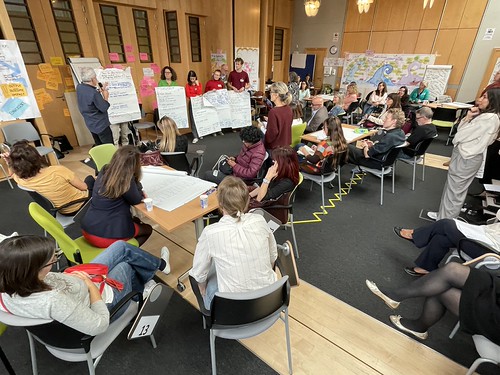
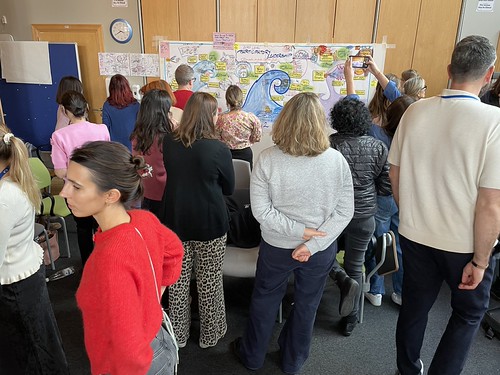
Last week, our team of eight hosts held the space, with our hands, our hearts and our minds, for nearly 60 colleagues from different departments and services across the European institutions. Everything that each person brought to this experience, whether as a participant or as a member of the hosting team, was invaluable to me. I feel deeply grateful to everyone who contributed to making these three days what they were.
Within the European institutions, it is both heartening and reassuring for the future to see new colleagues learning and practising participatory leadership. Active listening, a deep understanding of others and their perspectives, the art of asking questions and having meaningful conversations, and, ultimately, the ability to turn these conversations into meaningful action: all of these are essential for a European public administration navigating an increasingly VUCA and polarised world.

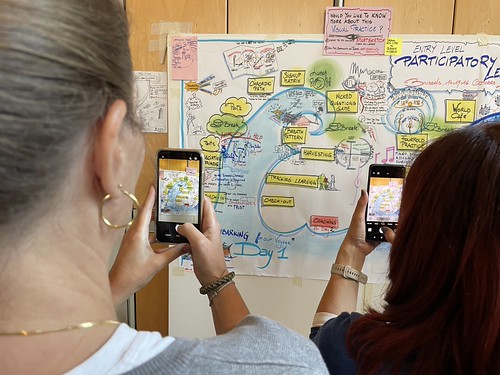
I am sharing a few photos from the training, together with my graphic recording on top of our 3-day agenda. We chose sailing as a metaphor for the journey, and it accompanied us throughout the training. Thank you to everyone who was part of this journey.
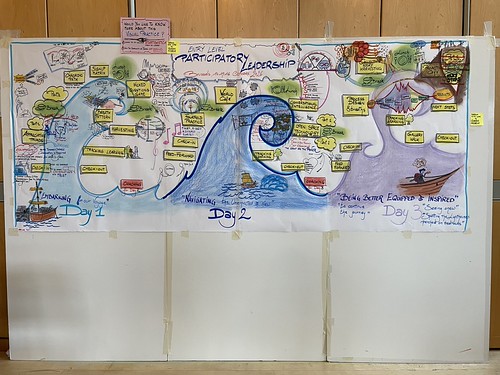
Participatory Leadership training course
Share on:

Hosting and harvesting online VS physical

On 5 May, Amy Lenzo (*) gave an online masterclass on “Hosting and harvesting online VS physical” to the community of practitioners of the Art of Hosting at the European Commission (**). My takeaways (actually apply to any online session):

“It’s not a question of technology, it’s a question of relationships” 

  • 90% of your experience, skills, practice as organiser of physical events can be transposed into online events. Reassuring, isn’t it?
  • The quality of your presence, trust and how you hold space, are just as important online as in the physical world
  • Never host alone an online session, be part of an hosting team
  • The hosting team must consist of at least one process host and one tech host (for all technical aspects) or more for large groups
  • The use of the camera is mandatory for speakers, and highly recommended for all participants (with muted mikes)
  • To keep participants’ attention, speakers can only use the visible/audible part of their body language: their face and their voice. Then, it’s crucial to smile with the whole face and to have a catchy tone and rhythm of voice
  • Keep in mind that everything is amplified online: your voice, your unconscious bias, space and time.
Hosting and harvesting online VS physical, graphic recording

This was also my first live graphic recording using the Procreate app (***). Only a few days after installing it on my tablet (it’s crazy, I know, but I like these challenges). My first learnings to start with Procreate:

  • Many years of experience with layers on Photoshop has helped me a lot. If you’re not familiar with layers, take time to learn how they work and to play with them
  • Select your fave brushes in advance. You can waste precious time looking for what you need during a live event. Mine were Technical pen, Acrylic and Wet Acrylic, and Hard Airbrush (I still have to learn how to have them available in one click)
  • Select your fave colours in advance for the same reason as for the tools (I still have to learn how to create my colour palette in advance)
  • Know the undo/redo gestures

(*) Amy Lenzo on Linkedin – Twitter

(**) At the European Commission, the Art of Hosting is called the Art of Participatory Leadership

(***) https://procreate.art/ipad

Share on: