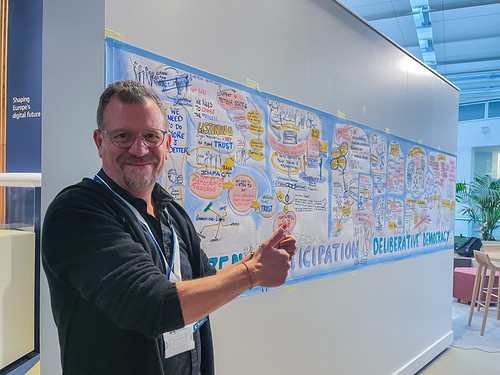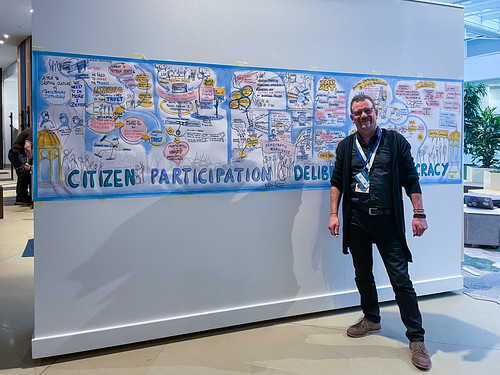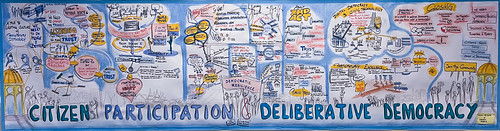
This year’s 6th Citizen Participation and Deliberative Democracy Festival focused on the role of participatory and deliberative processes in democratic resilience.
I was honoured to be invited by my fellow organisers at the JRC to work as a graphic recorder. The festival took place over three days at the Berlaymont, the European Commission’s iconic building in Brussels.
I listened carefully to the keynote speeches and panel discussions, and captured their main points in real time with my markers, on a large visual wall. You can see the final result in the video and take a quick visual journey through the topics discussed over the three days: How is the Commission walking the talk of democratic resilience? What’s new in citizen participation? What infrastructures for participation do we need?
I take away two main things from this festival. The first is about the content of the discussions. The second is about my own visual practice.
On the content of the discussions
Two concepts stood out throughout the festival, even when the discussions covered very different topics: trust and impact.
Trust is both a necessary condition for designing, inviting people to, and running participatory democratic processes, and a possible outcome of these processes. They can help build a relationship of trust between citizens and institutions.
Impact was discussed in different ways, particularly in relation to the results of participatory processes and their follow-up. Everyone agreed that a participatory and/or deliberative initiative should have an impact, whether tangible or intangible. This impact must be perceived by citizens, who need to see that institutions have taken their contributions into account after the initiative.
In this way, the impact, results and follow-up of these initiatives all help to build trust between citizens and institutions.
On my visual practice
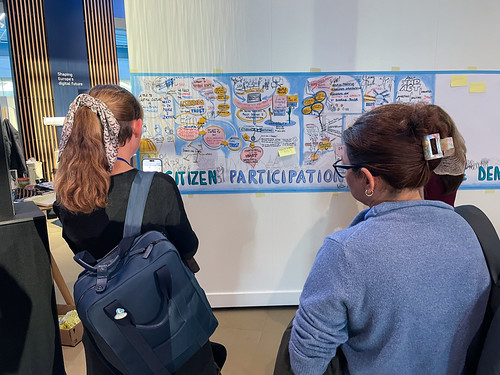
Participants and speakers could watch my work slowly take shape in real time on the visual wall, as the sessions followed one another. Some participants came to have a closer look, take photos or simply reflect on my visual interpretation of the conversations they had just taken part in. Others stopped to talk with me, either about the festival topics or about visual practice itself.
I enjoy graphic recording, but what I like most about it is interacting with people in front of my visual wall.
And this is precisely what makes the difference between a graphic recorder who works live, follows the flow of conversations during a conference and interacts with participants, and generative AI asked to create a visual summary of the same conference. I have no doubt that the quality of an AI-generated result could be higher than mine. It could have perfectly drawn icons and perfectly captured quotes from what was said. But despite all its power and technical perfection, an AI-generated summary remains cold, impersonal, decontextualised and disconnected from what happened between the people in the room. It cannot capture the energy and the vibes of the moment. In short, the summary lacks humanity.
And there is more. Or perhaps worse. AI may be able to do the job of producing a summary in an amazing way, but it cannot interact with participants. It cannot share their sense of wonder, ask them questions, answer their questions, or simply exchange a smile in silence.
Finally, as Christopher Fuller explains in his article, which my friend Marcello Petruzzi also refers to in his essay , human skills and artistic sensitivity will always have an irreplaceable value, despite the progress of generative AI. People will always have the desire and the need to take part in something created by another human being, and to experience an artistic expression that comes from the human hand and mind.
To bring everything full circle, I strongly believe that this human presence in artistic expression is an important element that can support and enrich participatory and deliberative processes. After all, as I write these words, these are still spaces where human beings meet.
For me, the point is not to defend human creativity simply because AI cannot draw as well as a human being. It is about understanding the value of what happens through the creative process itself: people meeting, thinking, interpreting and building meaning together.