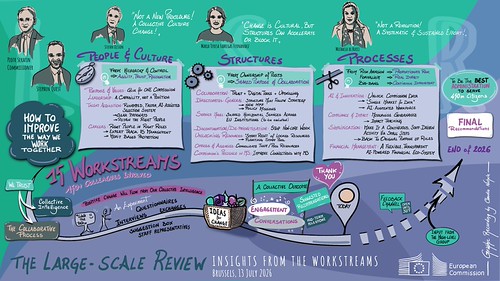
Visualising progress: the Large-scale Review all-staff meeting

LSR All Staff Event - Graphic recording

I’m happy to have contributed once again, through live graphic recording, to supporting my colleagues at the European Commission working on the Large-scale Review (LSR) initiative.

“What we call the Large-scale Review is the first organisation-wide review in over 20 years […] where colleagues from across the Commission have examined the way we work, identifying where we can simplify processes, strengthen collaboration and make our organisation fit for today’s challenges.”
Stephen Quest, Director-General for Human Resources

My contribution to this major collective effort to modernise the Institution has not been limited to graphic recording. I have also helped facilitate meetings using participatory and visual methods, conducted a large survey of managers, and taken part in many conversations along the way.

Capturing nine months of work in real time

In July 2026, the first results of nine months of work were presented to all staff at a large meeting.

My task was to capture a live visual summary of the discussion, covering dozens of recommendations across 15 workstreams, grouped into three clusters.

The task was not easy, given the volume, diversity and depth of the content. There were also some specific challenges and constraints.

  • First, the recording had to remain strictly factual. I had to capture what was said without adding interpretation or missing key points. This is quite different from my usual practice. Normally, I tend to listen more deeply and create a visual meta-synthesis that reflects the underlying ideas, connections and patterns. In this case, however, the role was closer to documenting the discussion faithfully in real time.
  • Then there was the pace. Speakers moved quickly, some read from prepared notes, and a series of important messages followed one another with very little transition.

In the end, the graphic recording was well received and shared with all European Commission staff as a supplement to the official communication.

More than a recording

Beyond the recommendations themselves, I’m delighted to see visual thinking gaining momentum.

As a tool for better thinking, collaboration and sense-making, it is increasingly being woven into our “New Ways of Working” and into our transformation journey.

After twenty-five years of practising this craft, it is rewarding to see it becoming more recognised in my organisation. I’m proud to be able to pass on this know-how and contribute to developing these skills among my colleagues. As I said in my other post about the first LSR all-staff meeting:

“The European Commission needs more creativity and innovative thinking to meet the complex challenges of today’s world. Visual thinking is a skill to be relearned, not just a tool, and it can help achieve this.”

And perhaps this is one of the most interesting aspects of the LSR journey for me: not only what we are changing, but also how we think, collaborate and make sense of complex issues together.

What do you think?

If you are a staff member of one of the EU institutions, you might want to spend a day with me and Célia Pessaud on the StartSketch course, where we explore the basics of sketchnoting. It can open up new perspectives on how you work with information, communicate and think visually.

If you are interested, search for “StartSketch” on EU Learn, or simply get in touch with me.

What do you think about the role of visual thinking in large-scale organisational change?

LSR all-staff event
Share on:

Beyond Visuals Verona 2026 : What do the participants hope to experience?

Logo Beyond Visuals Verona 2026

Visual thinking is my passion. It’s my favourite tool for work, meetings, reflection, communication, summarising ideas, and making sense of complexity.

A few years ago, I launched a sketchnoting course for colleagues at the European Commission, where I work (although not as a visual thinker). Through this course, I help people discover the power of visual thinking and explore how they can use it in their daily work.

Outside my day job, I am an active member of the global visual thinking community. Since 2017, this wonderful community has gathered every year in a different country to learn from one another, share experiences, and find inspiration.

This year, I am delighted to co-organise Beyond Visuals together with Federica Tabone.

The event will take place in Verona from 31 July to 2 August 2026. For the first time, the International Sketchnote Community (ISC) and the European Visual Practitioners (EVP) are joining forces to create one shared event, fully organised in BarCamp style.

The event is open to everyone, whether you are just curious about visual thinking or already an experienced practitioner.

But you may still wonder: What will I gain from attending?

We asked future participants why they want to come to Beyond Visuals and what they hope to experience in Verona. Their answers give a great insight into the spirit of the event and the conversations we will have together.

Here is my graphic summary:

Beyond Visuals: What Participants Say

Beyond the learning, networking, and inspiration, many of the answers reminded us of something beautifully simple: joy. The joy of geeking out over pens and paper, sharing good meals, discovering a city together, and creating memories that live both in sketchbooks and in the heart.

“Have fun laughter, nerd out over pens, paper, equipment, set ups.”
“Oh and new markers: you can’t have too many markers.”
“Good food, local vibes.”
“Discovering Verona together.”
“Fun and sun, Italian ice cream and pizza, coffee, and walks through the historic centre.”

This camp is not only about visual thinking. It is also about slowing down, being present, sharing experiences, and enjoying the little things that make creativity feel alive.

Renewal and impact
“The world is not that bad after all.”
“A revitalized belief that art and artists can make a difference.”
“I’d leave with the envy to do more with sketchnoting in my daily work.”
“A deep sense of gratitude for the renewed perspective I gained.”

Learning and growth
“There isn’t a single ‘right way’ to do this.”
“Hearing completely different approaches was energizing.”
“How different cultures can make working together so much better.”
“Find your own voice and style.”

Sharing and inspiration
“Many sketchbooks! Filled with hundreds of sights and insights.”
“I want to improve my drawing and boost my self-confidence.”
“I’d have really bad sketches too… reminders not to be perfect.”
“I feel the wind in my wings and total freedom in my creativity.”

People and connection
“A warm feeling of hugs from my (new) friends.”
“A big family, though we meet just once a year.”
“Reconnect, share our artistic practices, and discover Verona together.”
“The people and their openness in connection and sharing knowledge.”

If their words resonate with you, perhaps it is a sign that you should join us in Verona. Come and experience three days of learning, sharing, creativity, and meaningful connections with people who believe in the power of visual thinking.

Curious to know more?

Visit our event website, explore the programme, and secure your ticket before the available places fill up. Don’t hesitate to follow us on Instagram for the latest news.

Share on:

Sensemaking workshop

Workshop on Sensemaking - Graphic recording

“Sensemaking is the process by which people interpret, understand & give meaning to complex, ambiguous or unexpected situations. Figuring out “What’s going on” & “What should we do next”.

Under Maria Scordialos’ wise guidance, colleagues from DG HR, JRC and EC Centre for Organisational Transformation explored what sensemaking means in times of complexity and uncertainty.
It starts with listening to people’s stories on a shared topic. Then we look for patterns, map them, and discover patterns within patterns until insights begin to emerge, sometimes pointing to what we should do next.
What stayed with me most is this: the stories must be told by the people at the heart of the issue, and explored together with them. Sensemaking is a collective process that draws on the group’s shared intelligence, the more diverse the group, the richer the insights.
And one more thing: even an impromptu graphic recording like mine can help people make sense of conversations on complex topics.

This post on Linkedin and Instagram

Workshop on Sensemaking - Graphic recording
Share on:

Conflicts – When tension needs attention at work

Conflict, when tension needs attention at work - Sketchnotes

Looking back at an event I recently attended at Visuality EU. ​Entitled “Teams on Track”, the focus of the day was conflict(s), whether underlying or already out in the open. The morning featured a keynote by Professor Martin C. Euwema, followed by practical workshops in the afternoon.
My main takeaway (which I have attempted to capture in my visual notes) is that conflict, and the stress that accompanies it, are part of life. They are even essential to our survival. The key is not to avoid conflict, but to choose consciously the right strategy for addressing it. Whatever our personal style and sensitivity and that of the other party, whether more dove or more hawk, we often need to navigate between the two, depending on our goals and the context. Positioning oneself as a peacemaker, and actively practising and fostering peacemaking, particularly when leading a team, may well be the boldest approach. It is also, in many cases, the most effective way to address workplace conflict.
Thank you to the organising team and all the participants for such an inspiring day. One that, in its own way, gave me hope for humanity.

This post on Linkedin

Share on:

EU Sketchnote Day 2026

First #EUsketchnoteday

On Friday 16 January 2026, I held the very first day dedicated to sketchnoting within the European institutions. The idea was simple: to celebrate sketchnoting with colleagues who had followed the StartSketch course, and with anyone curious about the practice.

For this first edition, Celia Pessaud kindly agreed straight away to organise it with me. We chose to keep things light and flexible. Colleagues could drop in at any time, without registration, and stay for as long (or as little) as they wanted. We offered a few simple and playful sketchnoting activities. We began with a warm-up to step away from daily work and reconnect with creativity. Then participants could choose what suited them: sketching their 2025 retrospective, their 2026 resolutions, their hopes and fears for 2026, a visual agenda, or contributing to a visual dictionary of EU jargon. We ended with a large mural where everyone could leave a trace: an avatar, a thought, or a quote.

The atmosphere was calm and relaxed, but also full of energy. Smiles quickly turned into quiet focus as people leaned over their paper and started sketching.
Many told us they had barely practised sketchnoting since the course, but that the day gave them fresh motivation to start again. Others said that thinking visually helped them reflect differently, less linearly, and clarify their ideas. Several even suggested doing this every month.

So, what do I take away from this first EU Sketchnote Day?

  • First, it simply feels good for those who practise and for those who watch. It creates a different state of mind: more attention, better focus, stronger synthesis, and more creativity. And all this without needing to “know how to draw”.
  • I also realise that one day a year is not enough. The interest is clearly there. We will keep an annual celebration, but between those moments we could organise regular “Visual Fridays” to practise together around a theme or a concrete need. And we should keep building our shared visual dictionary.
  • Finally, what I treasure most is the reminder that I work with extraordinary colleagues. Starting with Célia, who supports all my visual ideas, and Catherine Focant, with whom I developed the introductory sketchnoting course.

Thank you all!

This post on Linkedin

First #EUsketchnoteday

Share on:

Large-Scale Review meeting – Digital graphic recording

LSR All Staff Event - Graphic recording

If you’re not part of the EU bubble, you may not be aware that the President of the European Commission, Ursula von der Leyen, has asked Commissioner Piotr Serafin to lead a large-scale review of the Commission’s organisation and operations, together with an external benchmarking exercise. The aim is to ensure that Europe has a modern, efficient public administration capable of delivering on its political priorities and improving the daily lives of Europeans.

Since April 2025, I’ve had the privilege of supporting, from time to time, the internal team working on this initiative. I contribute with the tools and capacities I know best, especially participatory facilitation and visual thinking, during consultation and reflection sessions with staff.

Last Friday, all European Commission staff were invited to a meeting, held onsite for some and online for most, where the main actors openly discussed the process behind the initiative. Among other things, they explained that the review seeks inclusiveness and collaboration to help shape a more agile, effective, and attractive Commission for the future. My role in this major event was to visually capture the key points from the discussions. For the first time, I worked from an interpretation booth, alongside the French and German interpreters, where my task was to “interpret” the room’s conversation into visual language.

My graphic recording was widely shared internally afterwards as part of the follow-up communication. The feedback I received, both privately and publicly, has been very positive and truly encouraging: colleagues highlighted how valuable visual harvesting is for complex, high-stakes discussions, appreciated the clarity and completeness of the capture, and praised how the visual summary distilled 1h15 of exchanges into a single, accessible image.

I’m proud to see how my practice of visual thinking, which includes graphic facilitation, sketchnoting, and graphic harvesting, has evolved from a tiny niche within the Commission more than 20 years ago to something now requested and used at high-level events. One of my greatest satisfactions is having helped bring this innovation into the Commission, equipping colleagues to think not only with text but also with hand-drawn visuals (icons, arrows, containers, etc.) for richer, broader and more inclusive reflection. I’m grateful to all those who believed in this approach, who had the courage to try visual thinking, and to everyone today who is keen to learn it.

The European Commission needs more creativity and innovative thinking to meet the complex challenges of today’s world. Visual thinking is a skill to be relearned, not just a tool, and it can help achieve this. This is my personal conviction and it is entirely my own opinion.

Finally, the making of the graphic recording:


Share on: