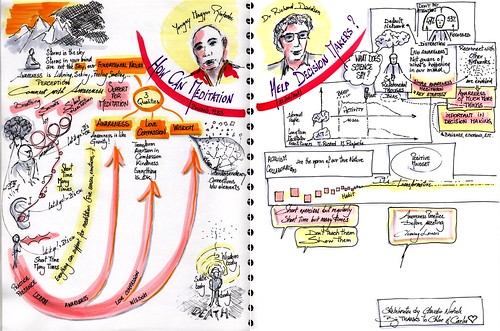
Here are my key takeaways from a session on “Emotional Awareness 101” by Alexandra Balahur, captured through live visual notes (sketchnotes).
Our emotions are there to help us respond to what our senses perceive and to formulate an appropriate reaction. This is why it is important to stay connected to all our senses and to our body, rather than relying only on our brain to make sense of what is happening.
Each of the six basic emotions has a meaning, a significance and a purpose. But emotions do not simply come in six fixed categories. Each one exists on a spectrum of nuances. Learning to recognise and name these nuances with greater precision helps us understand what we are experiencing, process it and soothe ourselves more effectively.
In the long term, emotional awareness is also about building our capacity to regulate emotions. One useful approach is to disengage, interrupt the cycle, and then re-engage with intention rather than reaction. Creating this small space between what we feel and how we respond can make a real difference.
We can also train our emotional capacity through a kind of “emotional gym”: small, regular practices that gradually increase the space in our emotional container, giving us more capacity to process emotions over time. This is what is called self-love or self-care: getting enough good-quality sleep, eating a healthy diet, practising meditation, breathing and mindfulness, maintaining social connections, having regular check-ins with ourselves and others, and making space for joy, hobbies and activities that energise us.
The key message I took away is that emotional awareness is not about getting rid of difficult emotions. It is about learning to listen to them, understand what they are telling us, create space for them, and choose how we respond.
Thank you Alexandra